Trail-Rossland Welcome the Province as 2026 BC Winter Games Open
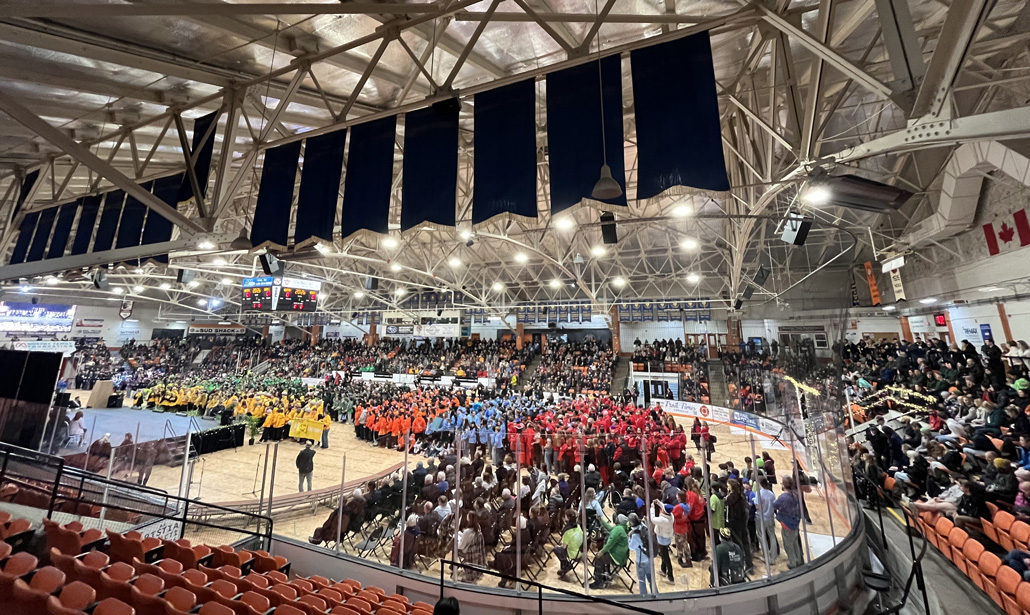
For hundreds of young athletes, the moment finally arrived Thursday night as the region welcomed more than 1,450 volunteers, 1,600 young athletes, and families from 131 communities across British Columbia who gathered to officially open the 2026 BC Winter Games. Before a single medal is awarded, before the first whistle blows or skis carve through snow, there is this moment: the roar of a crowd, the skirl of bagpipes, and a chorus line of high-kicking can-can dancers putting Kootenay culture on centre stage.
Inside the Trail Memorial Centre, teams representing 15 sports and 16 Provincial sport organizations prepared to begin four days of competition. Over the course of the Games, 930 medals will be awarded, but opening night was about more than podium finishes. It was about community, connection, and the shared spirit of welcoming the province to the Kootenays.
The ceremony opened with the Trail Pipe Band, with bagpipes echoing as hosts recognized Games officials, Indigenous representatives, and municipal leaders. Jared Basil of the Ktunaxa Nation welcomed athletes and families, noting that “sport and athletics have the ability to bring us together” and reminding competitors that “success is where preparation meets opportunity,” encouraging athletes to savour the experience. Herb Alex of the Sinixt Confederacy, and a former BC Winter Games alpine skiing participant, echoed that message: “It’s an amazing event. Have fun, stay safe and respect everyone.”
Athletes have travelled from every corner of British Columbia to be here, some from as far away as Prince Rupert, nearly 1,700 kilometres from Trail/Rossland. All athletes’ journeys involved 35 coach buses, 15 school district buses, three charter flights, and the careful coordination of more than 3,000 pieces of luggage.
For many, the opening ceremony marked the culmination of months, and in some cases years, of training, early mornings, and long travel days.
One by one, zones marched into the arena in a parade of colour and celebration:
- Zone 2 (RED) – Thompson Okanagan
- Zone 3 (Light Blue) – Fraser Valley
- Zone 4 (Orange) – Fraser River
- Zone 5 (Dark Green) – Vancouver Coastal
- Zone 6 (Light Green) – Vancouver Island Central Coast
- Zone 7 (Purple) – North West
- Zone 8 (Dark Blue) – Cariboo North East
- Lastly, lead by Zone 1 (Yellow) – Kootenays, led by Kootenay Olympian George Grey, who competed in 2006 and 2010, drawing cheers from the hometown crowd
The evening’s entertainment showcased the depth of talent across the region, blending tradition, athleticism, and community spirit.
Webster Elementary School Drummers opened the performances with synchronized percussion and setting an energetic tone. Team Senhaamrtham followed with a vibrant cultural performance that brought expressive movement and intricate choreography to the ceremony. The group, formed recently by leader Amrtha Mary, who performed together for the first time during the opening celebration. Mary said the dancers were “proud to represent traditional Indian classical dance and open for the BC Winter Games,” marking a meaningful debut to the group.
Speeches from Games officials and local political representatives underscored the scale of the event and the effort required to host it. Then came the high kicks. Rossland’s Boomtown Garter Girls energized the arena with their signature cancan performance.

“Bringing old-style cancan to the BC Winter Games stage was an incredible honour,” said Valerie Rossi, known on stage as Ruby Tuesday. “We were proud to celebrate history while delivering the kind of high-energy performance that turns heads.”
The troupe has been high-kicking across stages for more than four decades, carrying forward a dance tradition that traces its roots to 19th-century Paris before finding a spirited home in Rossland’s mining-era celebrations. “Cancan is as athletic as it is glamorous—precision, stamina, and heart in every kick,” Rossi said. “If we left the crowd buzzing, and a little breathless just watching, then we did what we came to do.”

For some, the Games involve more than one role. Summer Recchi took the stage with the Boomtown Garter Girls while also acting as Special Event Chair, assisting in the organization of the opening and other ceremonies. “This is one of the largest events we have ever performed at,” said Recchi. “We are very excited for the opening of the Games and look forward to adding some Kootenay culture and heritage to the Games and the rest of B.C.”
The Kootenay Men’s Choir and the Friends and Family Choir closed the entertainment portion of the evening, their harmonies filling the arena in a powerful final tribute to collaboration and shared effort.
Behind the event lies a massive logistical undertaking. Over the course of the Games, more than 17,000 meals will be served. Six schools have been transformed into athlete villages, complete with 1,593 foam mattresses and 101 classrooms converted into dorm rooms.
Volunteers range in age from nine to 92—a reminder that the BC Winter Games are powered as much by community spirit as by athletic performance. From transportation and food services to medical teams and event coordination, thousands of hours of volunteer effort make the Games possible.
Notably, 14 BC Games alumni have gone on to compete at the 2026 Olympic Games, highlighting the event’s role as a launchpad for future champions. As the ceremony built toward the lighting of the cauldron, the message was clear: the BC Winter Games are about possibility.


For the athletes marching across the arena floor, some competing in their first major multi-sport event, this moment marked the beginning of something bigger than competition. It marked the start of friendships, memories, and experiences that will last long after the final medal is awarded.
For the Trail, Rossland area, the Games are officially underway.
